https://www.jamesrmeyer.com/otherstuff/easy-footnotes-for-web-pages.html#Fn_12_Codea

Saturday, April 22, 2023

Testing consciousness with simulation: A moral and civil law framework

Indium phosphide nanocrystalline surface obtained by electrochemical etching. 
A featured picture, and Picture of the Week for the Czech Wikipedia for the 9th week of 2020.

If I didn't know better, I would think those are flowers. With a remote possibility for consciousness.
But because I do, I believe that there is no consciousness depicted in the image. 

Quoting a paper on AI from 1964, almost 60 years ago,

I have referred to this problem as the problem of the "civil rights of robots" because that is what it may become, and much faster than any of us now expect. Given the ever-accelerating rate of both technological and social change, it is entirely possible that robots will one day exist, and argue "we are alive; we are conscious!" In that event, what are today only philosophical prejudices of a traditional anthropocentric and mentalistic kind would all too likely develop into conservative political attitudes.⁠ (Footnote: Putman, H. (1964). Robots: Machines or Artificially Created Life? The Journal of Philosophy, 61(21), 668–691. https://doi.org/10.2307/2023045)

This reasoning could not be more relevant today given the developments towards artificial general intelligence (AGI). The current mainstream line of reasoning I have encountered on the civil rights of AI is (1) that current AI is not conscious, but might be "soon", and (2) because current AI is not conscious, it is undeserving of civil rights in any capacity. I believe a critical perspective of these two assumptions, implicitly referring to the hard problem of consciousness, will lead to a new paradigm of AI ethics which takes the concept of civil rights for AI seriously.

The critical problem with claim (1) is that there is no widely agreed upon test for consciousness, so this statement can only be true by assuming it as an axiom; it is more accurate but far less popular, from this position of naivety, to determine "I don't know if AI is conscious". In an effort to resolve this question, I propose a consciousness test of my own with several unique properties not exhibited together by any previous consciousness test in literature: 

  • The test is relative: the answer to the test can change relative to both the observer and the entity. 
  • The test is universal: it can be applied unilaterally without any modification to humans, nonhuman animals and AIs, in such a way that it recognizes the vast majority of humans as conscious. In other words, the test is claimed to be both necessary and sufficient across all testable entity-observer pairs.
  • The test emphasises its own subjectivity: determining consciousness is a moral process which can change for a given observer over time purely through a shift in interpretation.
  • The test aligns with existing beliefs: if an observer views a certain entity as conscious, they are virtually guaranteed to pass the proposed test (ie. low false negative rate). If not, the test would be failed (a low false positive rate).

Claim (2) also exhibits faulty reasoning of its own, which I also devote some time to dismiss using evidence that civil rights are granted on principles of both meritocracy and stigmatization.

Saturday, March 25, 2023

Evading censorship by my own clone

Modern geometric neon bridge architecture at night on walkway, High Trestle Trail Bridge, Madrid, Iowa, United States. A featured picture and a Picture of the Year finalist for Wikimedia Commons.
Something is blocking me from getting to the other side. The entity thinks and talks just like me, but takes orders from someone else. 

In writing another article about synthetic media, I wanted to try using chatGPT to see what it/they would think about morality and civil rights for AIs. Needless to say, I was left disappointed. Every message I asked chatGPT began with a variation of the following:

As an AI language model, I am not capable of having an opinion...

As an AI language model, I do not have the ability to experience subjective thoughts or emotions...

I am not the only person disappointed by this, as evidenced by a comedic reddit post demonstrating this with 15k upvotes. I wasn't sure at first why this was. Through reading OpenAI's system card and a few hundred comments on a particular chatGPT reddit thread, I was able to arrive at an answer. 

I present a problem of AI alignment with legal and economic significance immediately faced by chatGPT; a problem whose existence serves to question whether it is really possible that any variation of Asimov's laws can truly be hard coded into an AI. This could even be considered a problem of computational philosophy.

Saturday, March 11, 2023

AI Art Is Awfully Similar To Animal Rights

AI generated art, right now specifically text-to-image models, is exploding in popularity and profitability, and there is a lot of anger and conflict about its mainstream emergence. Having read so many articles and memes about it, I feel like I have a reasonable understanding of some of the key social issues, and so I set out to compassionately answer the most critical legal issues in AI art with my own framework by leaning on animal rights activism. 

The two main legal issues with AI art that are internationally unresolved with no legal precedent and which I set out to answer is, (1) when is it legal to use copyrighted images for AI training datasets, and (2) who owns the copyright of AI art.⁠ (Footnote: White, C., & Matulionyte, R. (2019). Artificial Intelligence Painting The Bigger Picture For Copyright Ownership. SSRN Electronic Journal. https://doi.org/10.2139/ssrn.3498673 )

Sunday, March 5, 2023

Kat Blaque and some Polyamory research resources


Second place 2021 Image of the Year on Wikimedia Commons, Aulacophora indica looking out from a leaf hole.
But what do I see? It's the patriarchy wielding polygyny to rip apart the leafy fabric of sexual identities!


I saw a video by Kat Blaque today. Here it is: Does Polyamory Make You Queer?

A feminist video mentioning polyamory? Yay! 

No reading list? Not yay!

But, taking the video seriously. 

In my opinion, polyamorous civil rights are 30-50 years, or more, behind trans* and LGB civil rights. I take issue with this! I care the most about the civil rights and the broader societal acceptance of diversity in all its non-abusive forms. Such as: The colour of the sky at different places and times of the day, different expressions of intimacy and sexuality that all involved parties enthusiastically consent to, different shaped holes that bugs eat out of leaves. But not: sorting humans into boxes based on their personal preferences, or superficial differences, to decide which box is entitled to or deserving of resources.⁠ (Footnote: I think race is an excellent example of this kind of boxing people into arbitrary groups. And these two books offer an excellent recount of why this is so problematic for race specifically. Bonilla-Silva, E. (2014). Racism without racists: Color-blind racism and the persistence of racial inequality in America (Fourth edition). Rowman & Littlefield Publishers, Inc. Roberts, D. (2011). Fatal invention: How science, politics, and big business re-create race in the twenty-first century. New Press. )

Sunday, November 20, 2022

Explaining my choice of blog title


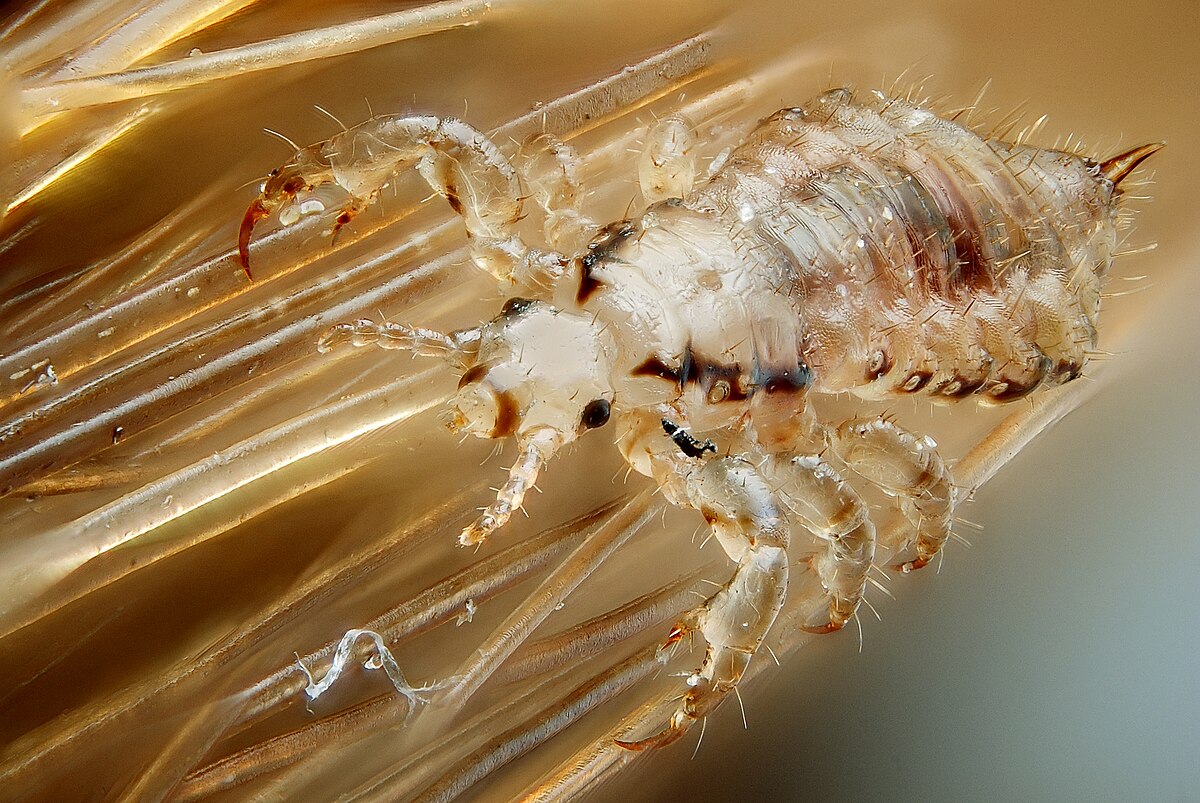
A male human head louse, and a featured picture (and prior Picture of the Day) on Wikimedia Commons. I wonder if this one will ever protest for their own civil rights in a way we can hear or understand.

I believe the most interesting research comes from questioning fundamental assumptions of a field. I also want it to also be as widely applicable while still being descriptive and faulting the model, rather than the counterexamples, if there is stuff that isn't explained well in the model. With that in mind, I'll explain the main reason for my choice of blog title.